By Luke Durling
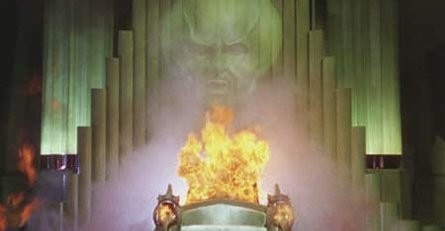
When I was in high school, I begged my play director to do the unthinkable, put on The Wizard of Oz for reasons I couldn’t fully explain at the time. Mainly, it was to play that snake oil peddling yet giant (floating) headed character of Oz himself. As someone who could not sing or dance, The Wizard was an extremely rare opportunity for me to get a leading role that required none of it. All I had to do was be a head turning head that turned into a regular, old man. Seemed like a dream come true, and it was. With help from a small village of people, but mainly my friend Emanuel Holder who played the part with me, I was The Wizard and it was wonderful. We were wonderful, the rest of the cast was wonderful and we put on what I personally think is one of the best shows that Hudson has ever done. Working with my Grandma Jean that had been taking me to the play backstage and front ever since I could crawl was probably the most wonderful part of it all though. Seeing her grin in the crowd was so special, especially when I had seen it so often over a needle and thread.
In retrospect, however, as I listened to the Wicked soundtrack while watching the sun rise a few days ago, I was reminded of another reason why I wanted to be the Great and Powerful. In a way, I saw myself in a similar light, an indelible imposter who had far reaching influence with very little authority or ability. I was an honor student with a big mind, but with no real idea what I was doing. My prospects were unlimited, yet I felt like I was being selfish for some strange reason. I still get pangs of this syndrome every few weeks or so and it gets pretty annoying at times. What I do is good, but I also don’t feel like it is often good, grand or great enough. My actions are seemingly a proverbial smokescreen in a world that seems to be more real outside of my jaded palace.
Then again, green is always greener than it seems to the one who wears it. (A frog taught me that.) A person can be good and feel as if they have made no impact at all. We only become the floating, empty promise of a person when we allow ourselves to feel this way all the time and therefore become ambivalent. When we don’t value our actions- whether it be out of fear, frustration or sadness- we reduce ourselves to the level we think the world is reduced to, which could not be further from the truth. There was real magic in the Land of Oz, real power, genuine witchcraft and wonder, yet The Wizard was a man who used fake magic and deception to stroke a fragile ego. He “was merely blown here by the wind”, after all. A man who saw no value in who he really was, so he created a fiction of greed and lies because that’s what he saw the world as. It is okay to long for things like intelligence, love, courage, community and other things because we all truly deserve these things. When we doubt our propensity to have and deserve them is when we must keep our ego from being taken over by a false notion we have to steal, lie and buy them. Sure, Oz might have found success, but it was the gratification of the success itself that defined him, not the self confidence that comes from success and personal growth. At the end of the day, Oz was exactly what he thought of himself behind the glittering curtain, a “dime-a-dozen, mediocrity.”
Of course, there’s nothing wrong with having these fears temporarily. Courage is fear processed, and is natural. Dorothy was afraid countless times, but was never afraid to be her good self. That is the difference. While life might be difficult, we should never doubt ourselves for the good we have and place into the world. I might have wanted to be The Wizard, but I know I am much greater and powerful than him because I am not anything except me, no matter what the flying monkeys of my fears say from time to time.
 Calm and Cultured
bjbrownconrod
Ienjoyed
LikeLike
Ariana and Luke Durling
Thanks! There should be a lot more on the way!
LikeLike